Most of The Circuit Has an “Evidence” Problem.
By: Aadi Patel
Here’s a cool debate fact (or at least, I think so). Back before the circuit was blessed with high-speed, large storage computers and technology like Verbatim (thanks Aaron Hardy), people debated off paper, which is definitely a lost art. That meant debaters would copy articles/sources and cut out the relevant portions to put on an index card. That’s where we get “cutting a card” from.
In theory, all this debate tech should allow us to fix evidence issues. Nope, we can now churn out argumentative slop at unprecedented speeds. I see these major problems in most cards:
- They lack warrants
- They lack a proper citation
- Debaters don’t take advantage of technology
- Questionable formatting (maybe I’m nitpicking)
So, I’m going to go through these problems, and how we can fix them.
Lack of Warrants
A warrant is the reason a claim is true. Without it, your “argument” is an FYI that somehow will make it into many RFDs, but that’s a separate issue.
The main issue with having just the claim is that there’s no reason to believe it. I could say “nuclear war causes extinction,” which obviously isn’t true until I find a warrant for it (or maybe it’s not true even with a warrant…)
Here’s an example of a card from a top school that lacks warrants. But why?
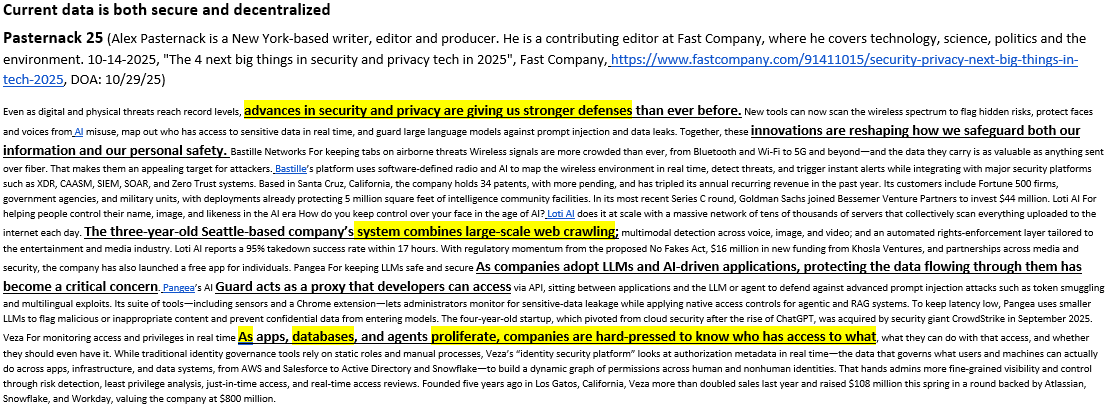
Let’s look at what the card says. It claims that “current data is both secure and decentralized.” The card text says “advances” such as “databases” are creating “stronger defenses.”
Someone who has cut a card or two
Let’s pause for a second.
Databases store data. That is the entire concept. What’s unique about these?
And where does it mention decentralized data?
Many of you are guilty of this. Including judges who decide to let it slide when they are instructed to “read” evidence after the round.
Here’s a better example.
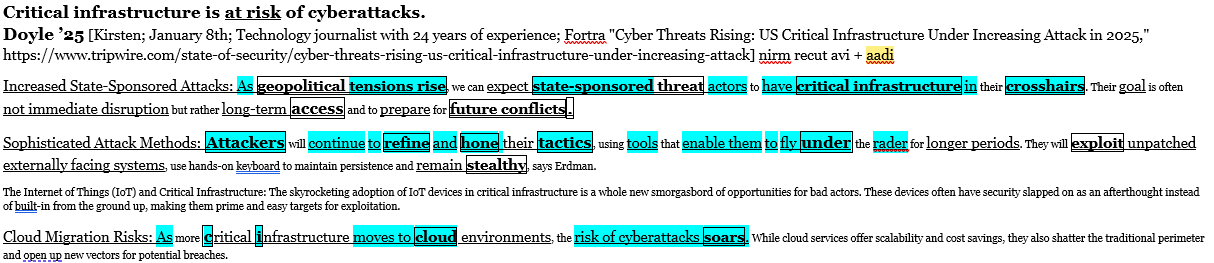
This card claims “critical infrastructure is at risk of cyberattacks.” It outlines 3 causes: rising tensions motivate state sponsored actors, continuous advances in tactics enable stealth, and cloud environments increase the risk. I’ve left the names of the people who cut this card because I think they did a phenomenal job.
Lack of Proper Citations
What is a “proper citation” anyways? According to the NSDA, it includes:
- Full name of primary author and/or editor
- Publication date
- Source
- Title of article
- Date accessed for digital evidence
- Full URL, if applicable
- Author qualifications
- Page number(s)
A lot of these aren’t part of every source, at least on face. Here are some tricks to find them!
- For the publication date, either:
- Use the source code by right clicking the page à view page source à Ctrl-F these terms: datePublished, article:published_time, pubdate, publish, dateModified, article:modified_time, modified (if you find dates with this method, use caution. They can be accurate, but they can also reveal someone has updated the article every week since 2014 for some reason).
- Sometimes, the date is embedded in the URL (eg. 10/08/2025).
- For author qualifications:
- If the source is something like a company, organization, etc., they might have an “about X person” page.
- Google the author’s name and find a Linkedin profile or web page that aligns with what you know about them. Be careful—John Doe the carpenter is a totally different person than John Doe the international relations expert, even though many debates treat them as interchangeable. Do evidence comparison, please.
I also want to clear up a common misconception. People, often in theory debates, claim the NSDA mandates a URL. It actually requires a citation “to the extent provided by the original source,” and a full URL “if applicable.” If everyone knew this, “URL theory” would be reduced to nothing in cross.
Making cites can seem hard. Luckily, there’s a fast, free, easy way to simplify it—the browser extension Cite Creator (another Paperless Debate lifesaver)! To use it, pin the extension to your browser, click the logo, and turn it on. From there, click options to customize your settings, or even make your own custom citation format. Here’s mine:
%last% '%y% [%first%; quals; %date%; "%title%;" %publication%; %url%; DOA: %accessed%] aadi
Technology and Formatting
I’m going to group the last two issues since they’re related. Poor formatting often relates to not using the right tech.
Cutting cards is now extremely easy. With Microsoft Word and Verbatim, you can copy an article, paste a citation, format tags, underline text, emphasize key phrases, condense irrelevant sections, and standardize highlighting in under two minutes.
Verbatim is powerful. It allows you to:
- Cut cards quickly
- Rehighlight efficiently during prep
- Navigate large backfiles without lag
- Create send docs, read docs, and disclose with minimal effort
What it does not do is decide which words matter. That part is still your responsibility.
But how should a card look? It’s subjective, but there are concrete dos and don’ts:
Do:
- Make your tagline and cite (Author YY) bigger/more visible (for example, font size 13 and bolded). Here’s what not to do:

- Underline only the relevant portions of the article.
- Emphasize what you want to stress during your speech/what you want the judges/opponents to see.
- Highlight to form at least semi-coherent sentences.
- Shrink all non-underlined text to maximize readability.
Don’t:
- Shrink text so much that your opponents can’t read it.
- Underline whole paragraphs and punctuation.
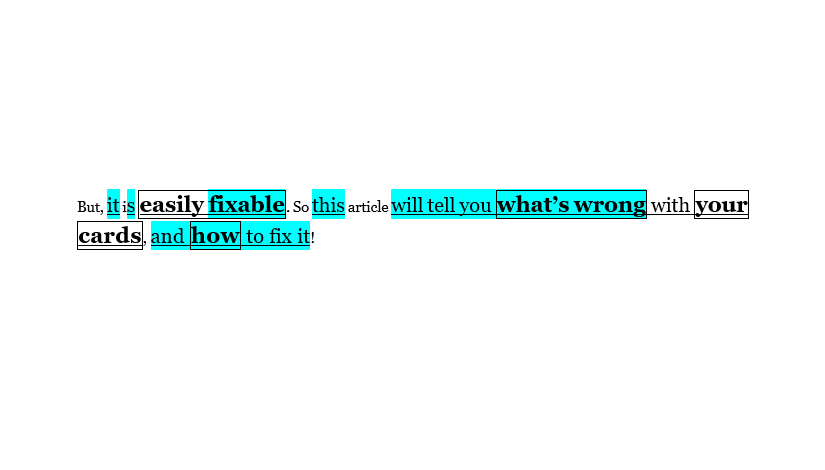
- Emphasize unnecessary words. The person responsible for this horror knows who they are.
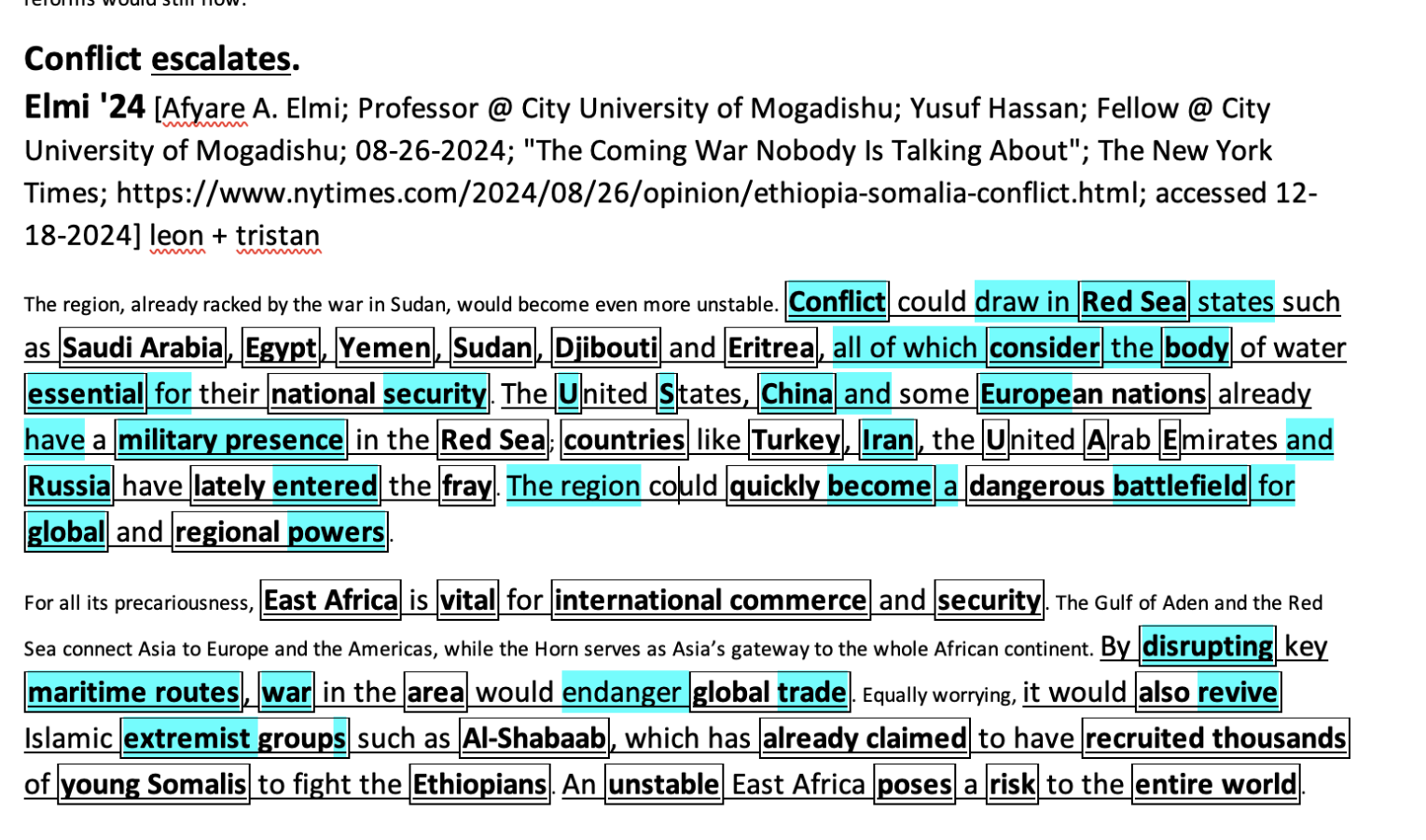
- Highlight sporadically, forming gibberish.
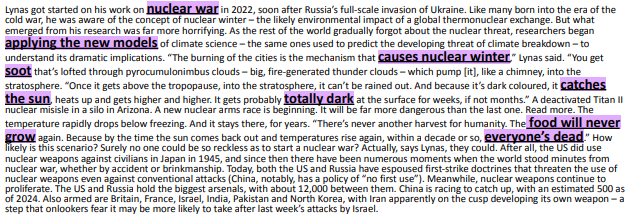
Out of all these mistakes, the one I see most is gibberish highlighting. I think this encourages people to form a complete argument in a tagline and then barely support it in the card text. And since judges almost always flow by tag, it becomes an unethical game of competitive nonsense.
It also benefits you to highlight coherently! Judges will understand what they’re listening to (or looking at after round). And cards highlighting full warrants is a lost art of making cards say something that a judge remembers 2 minutes after reading it. You’ll get better speaker points, especially from coaches/policy judges.